Easterford Lodge · Est. 1890
The Easterford Lodge Banner
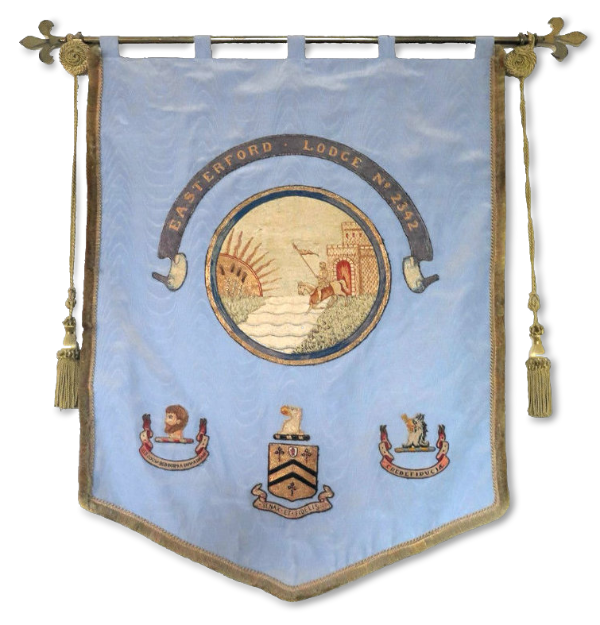
At the time of the Consecration a banner was made and presented to the lodge by two sisters both named Turner related to the founder member John Turner, the Innkeeper of the Angel, and a Founder member. In 1951 it was renovated by W.Bro. Jack Cooper, the Master of the Lodge in 1950. In 2000 it was renovated by Mrs. Jean Lawrence, the widow of W.Bro. Ken Lawrence who was Master in 1995.
The Easterford Banner is rich in both symbolism and mottoes. There are no obvious Masonic symbols, the founders were more supple than that. The colour of the background is the colour of the Masons apron. The banner is edged in gold which symbolises Grand Lodge and the Roundel the rising sun, the symbol which brings peace and salvation to the faithful.
The Lodge Banner is displayed on the north wall of the Temple. It was agreed in 1990 that all future initiates and joining members were to be informed of the meaning and mottoes emblazoned on the Banner. After considerable research it was not until 2005 that W.Bro. Henry Heath was able to present a paper. At the meeting in July 2023 W.Bro. Paul King presented an updated version with pictures produced by W.Bros. Norman and Stewart Eastbrook.
The Easterford Lodge Banner
The Heraldic Devices
The Rev Thomas Lloyd
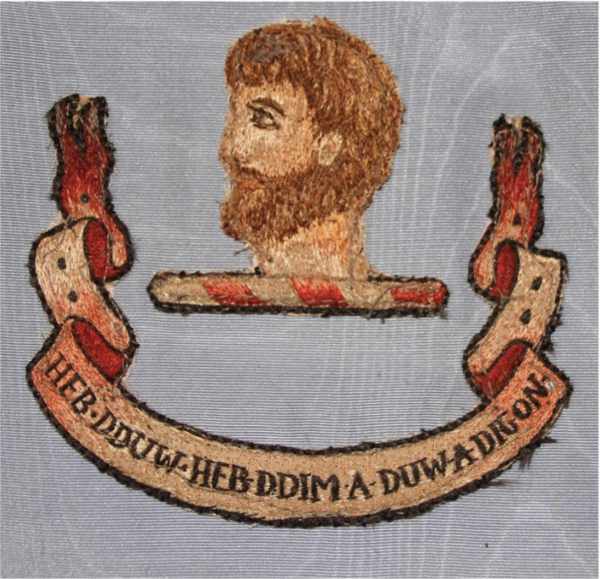
The heraldic device on the left of the banner represents our first Master (the Rev'd Thomas Lloyd) and shows a man's head surmounting a bar of alternating red and gold and the words Heb Dduw Heb Ddim a Dew a Dignon.
The man's head signifies honour, and the lodge has no greater honour to bestow on a man than that he should be its master and to be its first master is the supreme honour.
The red and gold alternating bar beneath indicates magnanimity and generosity, both qualities which are highly prized among masons whose distinguishing characteristic is charity which (like its sister mercy) blesses him who gives as well as him who receives.
The motto Heb Dduw Heb Ddim a Dew a Dignon is in the Welsh language and means (in English) "without God there is nothing, with God there is everything." The first thing every mason must do when he enters the lodge for the very first time is to reply to the question "In all cases of difficulty and danger in whom do you place your trust" with the simple answer "In God."
Dr Salter
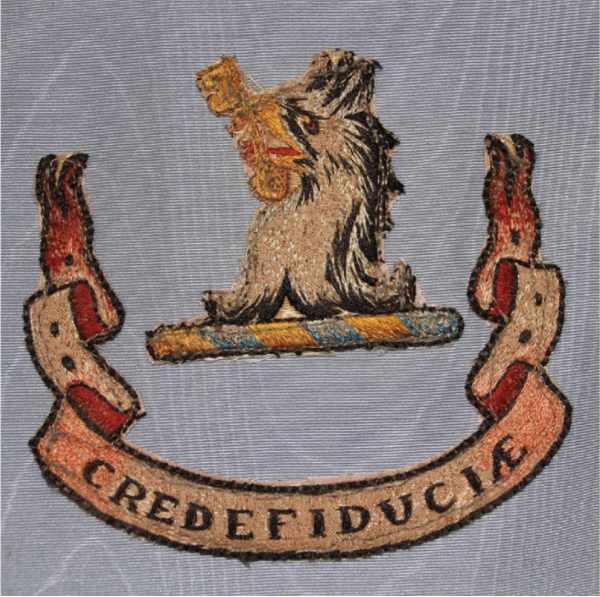
The heraldic device on the right of the banner represents our first Senior Warden (Dr John Salter) who became our second Master. It shows a boar's head with a key in its mouth surmounting a bar of alternating blue and gold and the word Credefiduciae.
The boar's head signifies hospitality and (if you were to consult any of the early menus for this lodge) you would have no doubts at all about the hospitality practised here in the past. The Easterford members hope our guests will find that our Festive Board will reflect the aspirations of the founders and will have lost none of its former splendour.
The key represents guardianship and all Easterford members know how well the spirit of Dr Salter has guarded this the Easterford Lodge No 2342 down through the years since its formation in 1890.
The blue and gold alternating bar beneath indicates loyalty, truth and generosity, again qualities which are requisite in every mason. The motto Credefiduciae is Latin for "believe, ye the faithful", a further exhortation to believe in that supreme being who rules over all.
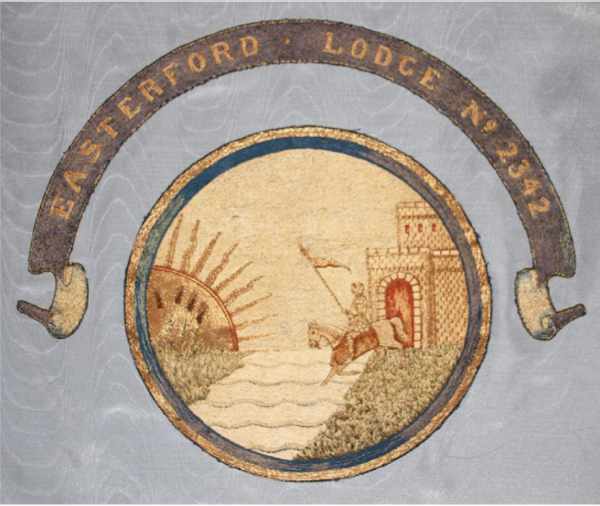
The Roundel: A Knight About to Cross a Ford of Water
We were given a good guide in a report of the consecration proceedings which appeared in the Essex Standard and said: "The banner of the Lodge in the centre of which is a representation of a knight about to cross a ford and the arms of the W.M. and S.W. has been most artistically executed by the Misses Turner of Kelvedon."
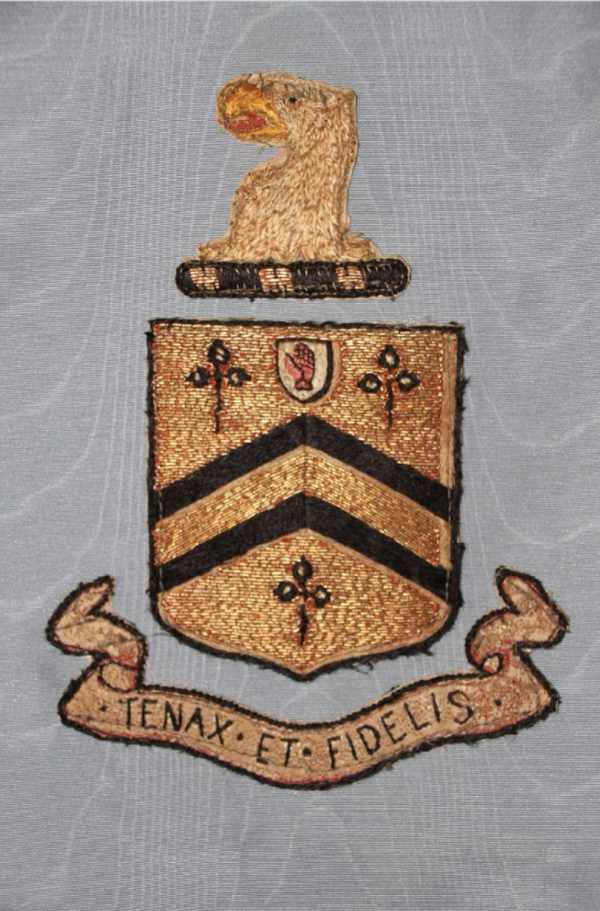
Unfortunately, no mention was made of the altogether grander coat of arms in the centre, and our research was not entirely satisfactory in this respect since everything points to the fact that it shouldn't be there at all. The reason it is there may seem at first glance to be obvious since it is (in fact) the coat of arms of a branch of the Abdy family, and Sir William Abdy was the great benefactor who paid to have this wonderful temple built in 1895.
However, the banner was present at the Consecration of the Lodge on 19th March 1890 and Sir William didn't appear on the scene until 26th February 1891, nearly a year later. The fact that it wasn't mentioned in the newspaper report of the consecration is a strong indication that it was a later addition to the banner to honour the generosity of Sir William Abdy who (in 1895) contributed £2,300, a sum which (in today's money 2023) would have been well in excess of £1.5m.
The Abdy Crest: Tenax et Fidelis
The Abdy symbols include an animal's head which (rightly or wrongly) we have assumed is a Talbot or hunting dog on a bar of alternating blue and gold above a shield with two chevrons, three trefoils and a shield within the shield bearing a red hand, underneath which is the motto tenax et fidelis.
The Talbot's head signifies courage, vigilance, and loyalty. The blue of the bar indicates loyalty and truth. The gold represents generosity, and no one could have been more generous than our benefactor Sir William Abdy. The chevrons represent protection.
Trefoils signify perpetuity, so the qualities claimed by the other signs and symbols are to be seen in the context of endless duration, perhaps a reminder to each and every member of Easterford Lodge that we should ensure (through our good stewardship) that this wonderful temple will endure until time shall be no more.
A shield within a shield represents a defender and (as the shield contains a red hand representing faith, sincerity, honour, and justice), we members of Easterford should be seen as the defender of faith. Underneath all these symbols are the Latin words Tenax et fidelis which translate roughly as "preserving and faithful".
The Symbols in General
So, we have a great many symbols and symbolism on the banner grouped under the headings of: the Lodge crest; the symbols and motto of The Rev'd Thomas Lloyd; the symbols and motto of Dr John Salter; and the arms of Sir William Abdy. Some symbols are duplicated, others appear only once, but they're all pointers to the behaviour and lifestyle to which we (as men and Masons) should be committed under the general headings of the basic principles on which we're founded: brotherly love, relief, and truth.
Brotherly Love
From the Roundel we have the noble knight which reminds us of a courteous and chivalrous age. From the Heraldic device of the Rev'd Thomas Lloyd we have the man's head signifying honour. From the Heraldic devices of Dr John Salter and Sir William Abdy we have the blue on the bar which signifies loyalty. From the Crest of Sir William Abdy we have the chevrons and the shield within a shield which remind us to protect each other, trefoils which remind us that our obligation is for life, and the red hand of honour which reminds us that we should be sincere with and just towards each other.
Relief
The fields of corn near to a fall of water on the Roundel remind us of the plenty each of us have compared to others in this world who are less fortunate than ourselves. The bar of alternating red and gold on the Heraldic device of the Rev'd Thomas Lloyd signifies magnanimity and generosity. The boar's head on the Heraldic device of Dr John Salter represents hospitality, and gold on the bar beneath represents generosity, as does the gold on the crest of Sir William Abdy.
Truth
Belief in God is the first and most important principle of Freemasonry; it undergirds all our ceremonies and underpins all our lives. From the Roundel we have the rising sun which reminds us of that bright morning star which brings peace and salvation to the faithful. On the heraldic device of the Rev'd Thomas Lloyd, the words Heb Dduw Heb Ddim a Dew a Dignon remind us that without God we have nothing but with God we have everything. On the heraldic device of Dr John Salter, the blue on the bar represents truth and his motto crede fiduciae reminds us to believe in God. On the crest of Sir William Abdy, we have the red hand signifying faith.
Secrecy
The key in the mouth of the boar's head at the top of Dr Salter's heraldic device refers directly to this important aspect of Masonry. Masons promise to keep secret anything they are told in confidence. However, a mason is only bound to respect the confidence providing it doesn't involve anything unlawful in the eyes of God or our legal system.
The full version of W.Bro. Paul King's paper is available at the Hall.